How To Do Sober October
- What Is Sober October?
- Sober October, Week By Week
- Sober October Cravings: What To Expect
- Pressure From Friends: The Surprise In The Data
- How Much Money You'll Save
- Struggling With Sober October? Read This First
- Does Struggling With Sober October Mean You Have A Drinking Problem?
- What To Do If You Slip
- After Sober October: What Happens On November 1st
- Sober October FAQ
- About The Data
Medically reviewed by Joseph Volpicelli, MD, PhD
Sober October is simple to describe and, for most people, harder than it sounds. It’s a month without alcohol, starting on October 1st. Some would call it the autumn cousin of Dry January, less famous but, based on the evidence we’ve seen, more often finished.
This guide covers what Sober October is, how to get started, what actually happens week by week, and what to do if you slip.
Most of the numbers come from The State of Sober October 2026, Oar Health's survey of 1,260 American adults who drink at least monthly, including 163 people who had done Sober October before.
| Key Takeaway | What The Data Shows |
|---|---|
| There are no official rules | Only about half of the people planning Sober October intend a fully dry month |
| Most people finish | 85% of those who attempted it said they completed the month, and 44% found it easier than they expected |
| Cravings end it, not parties | People with strong cravings were five times as likely not to finish as people with none |
| The first two weeks are hardest | 72% of participants who had cravings said they peaked in weeks one and two |
| Slips still come later | Half of the people who did not finish got past day 14 first |
| The money is what people notice | 64% noticed the savings, most commonly $100 to $250 for the month |
| The change tends to stick | Seven in ten drank less in the months that followed |
What Is Sober October?
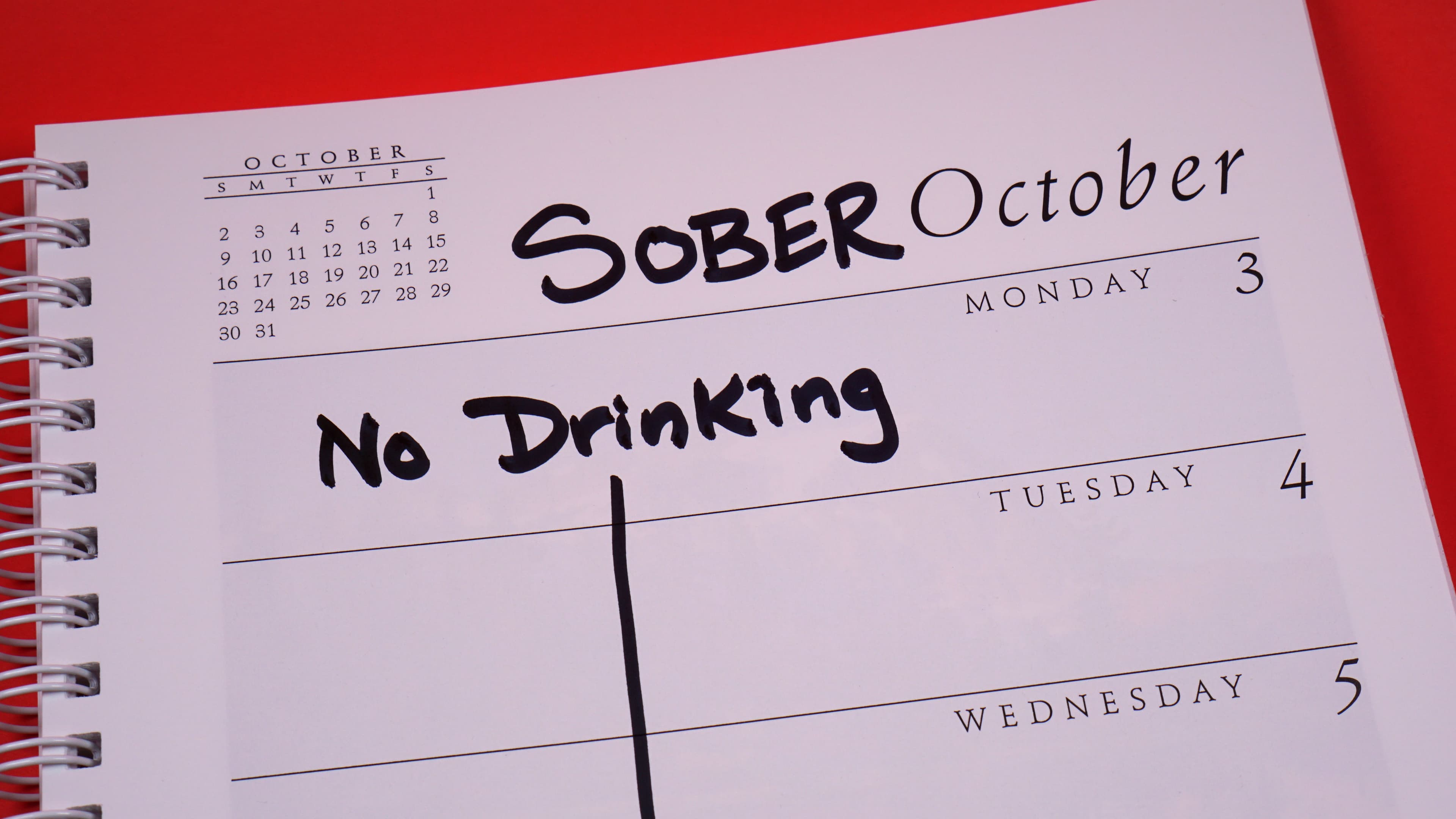
Sober October is a challenge to go without alcohol for the 31 days of October.
Originally, Sober October was a fundraiser. Australia's Ocsober, run by the children's health charity Life Education, began in 2009 and ran for more than a decade. Then in the UK, Macmillan Cancer Support launched Go Sober for October in 2013, and more than 30,000 people signed up in its first year. In the US it spread mostly by word of mouth, helped along by comedians on the Joe Rogan Experience, who turned it into an annual bet in 2017, and by the wider sober-curious movement.
Unlike Dry January, which arrives after the holidays, Sober October arrives well before them. That timing matters, as it gives you a chance to reset while routines are still settling after summer. Plus, it ends four weeks before Thanksgiving, the start of the year's heaviest drinking season.
It also remains something of a secret. In our 2026 survey, 61% of American drinkers had heard of Dry January and only 30% had heard of Sober October. Just 13% had ever tried it. Among drinkers over 62, awareness was as low as 12%.
The Rules Of Sober October (There Aren't Any)
Sober October has no governing body and no rulebook. You decide what your October looks like, and you should decide before it starts. In general, the people we surveyed were planning three versions:
Fully dry. No alcohol from October 1 to October 31. About half (52%) of people considering Sober October planned this.
Mostly dry, with an exception or two. A wedding, a birthday, one planned night. 18% planned their Sober October this way.
Cutting back. Drinking, but less than usual. 11% planned their Sober October this way.
The rest (19%) hadn't decided. If that's you, it’s best to decide now. A clear and reasonable plan is the best strategy as people who found the month harder than expected were far more likely to give up.
For the record, we don’t think that a damp October is a failed Sober October. Many people who want to change their drinking are aiming for moderation, not lifelong abstinence. A month of drinking less leads to many long-lasting health benefits, especially if one continues to refrain from excessive drinking. Perfect abstinence does not have to be your goal, but if you want a fully dry month, though, say so out loud, because "one won't hurt" is a much harder line to hold when you never drew it.
Who Does Sober October & Why?
People considering Sober October gave us their goals: better health (70%), saving money (56%), better sleep (45%), weight loss (43%), and drinking less overall (40%).
A month off is one of the few health resolutions that pays you back in cash, which is why money ranked so high, and why it ranked first among the things people actually noticed.
Sober October, Week By Week
Cravings arrive early and fade. Slips don't follow the same clock. Here is what the month looks like for most people, and what to do at each stage.
Before October 1st
Pick your version (see above) and write it down. You’re aiming to commit.
Tell the right people, not everyone. Most participants told only a few close people (52%), and a third told almost no one. Telling more people had a cost: 57% of those who told everyone felt pressure to drink, against 15% of those who told nobody. Pick two or three people who will back you and skip the announcement.
Plan for cravings, not parties. Cravings were the most common reason people gave for a first drink. Celebrations ranked fifth. Our guide on how to stop alcohol cravings could really help here.
Set up the money. Move what you'd normally spend on alcohol into a separate account each week. The savings is the first benefit most people notice, and seeing it could really help your motivation.
If you drink heavily every day, talk to a clinician first. Stopping abruptly after sustained heavy drinking can cause withdrawal, which in some cases is dangerous. See alcohol withdrawal symptoms, and don't tough out shaking, confusion or a racing heart.
Week One (October 1st to 7th)
This is when cravings are strongest: 37% of participants who had cravings said they peaked in week one. Nine of the 24 people in our survey who didn't finish had their first drink in this week.
The good news is that the early benefits are quick too. Sleep and mood tend to improve within days, and by the end of the first weekend you'll have your first week of savings.
What helps: keep evenings busy, have non-alcoholic drinks you actually like in the fridge, and treat the first weekend as the first real test. If you make it to Monday, you have the first of the two hardest weeks behind you.
Week Two (October 8th to 14th)
This is still peak territory, as 35% of those with cravings said they were strongest in week two. But this is also when the month starts to feel real. Day 14 is the halfway mark, and in our survey it was the median day of a first drink among people who didn't finish, which means the second weekend is a moment to plan for, not coast through.
What helps: check the account where the money is going, notice what has changed in your sleep, and book something for the third weekend that doesn't involve a bar. October is fall, so a nice hike could be the move.
Week Three (October 15th to 21st)
Good news, the cravings should ease. Only 17% of those with cravings said they peaked here. This is the week most people describe as easier than they expected, and 44% of participants said the month overall was easier than they'd braced for.
Week So far so good, but you are not out of the woods yet.. Half of the people who didn't finish made it to day 14. First slips in our survey ran as late as day 22. The real risk in week three isn't the craving; it's you telling yourself that you've proven the point.
What helps: keep the plan you made on October 1st. You don't need a new one just because it's going well. Also keep track of some of the beneficial effects from your efforts. Maybe you have lost weight, saved money, slept better, or find yourself enjoying other people more.
Week Four & Halloween (October 22nd to 31st)
By now, cravings should be at their lowest as only (11% of people who experienced craving reported peak craving this week). The only remaining hurdle is Halloween, which is the one night in October that is genuinely built around drinking. Nobody in our survey reported a first drink after day 22 (a small group, so read that as encouraging rather than guaranteed), so if you reach the last week intact you are very likely to finish.
For more on this, our sober-curious Halloween guide covers the night itself.
Sober October Cravings: What To Expect
Cravings are the part of Sober October nobody warns you about, and they are often the part that decides it.
In our survey, 58% of participants had alcohol cravings, about the same as in Dry January. What differed was how much they mattered. Craving turned out to be an important factor in people who did not finish the challenge:only 6% of people with no or mild cravings failed to complete their goal for October. This dramatically increased to . 24% with moderate cravings and 39% with strong cravings.
Put another way, people with moderate or strong cravings were nearly 5x as likely not to finish as people with little or none. Two things follow from that.
First, if you get strong cravings, it is not a character flaw. Cravings are a physiological response, and associated with heavier drinking. heavy drinkers who had done Sober October, 92% had cravings and a third had strong ones.
Second, research shows that alcohol cravings can be managed. In addition to psychosocial strategies to cope with craving, medications approved for alcohol use disorder, especially naltrexone, work on cravings directly; you can read how in our guide to alcohol cravings and our page on naltrexone.
"People who drink heavily aren't avoiding Sober October because they lack willpower," says Joshua D. Lee, MD, Oar Health's chief clinical adviser.
"In my experience, they're avoiding it because they've learned that willpower isn't enough. Cravings are a physiological response, and we have effective ways to treat them."
Pressure From Friends: The Surprise In The Data
Ask people what will make Sober October hard and most will say other people. The data says otherwise.
In our survey, 43% of participants felt pressure to drink, which typically came from friends (91%) and, more than in January, from colleagues (36%). Yet people who felt pressure finished the month at almost the same rate as people who didn't: 16% of the pressured group didn't complete, against 14% of the unpressured group.
But that doesn't make the pressure pleasant. Our guide to setting boundaries and saying no has scripts for the work happy hour, the wedding, and the friend who pours whiskey into your soda. The short version: "I've already got a drink" ends most conversations, and you don't owe anyone the longer version.
How Much Money You'll Save
Money is the benefit people notice first. Asked what they noticed during the month, past participants (n = xxx) put saving money (64%) ahead of better sleep (50%), a clearer head (47%), a better mood (44%) and more energy (43%).
Only 4% noticed no benefit from their Sober October experience.
And the amounts are real. Among people who gave an estimate, the most common saving was $100 to $250 for the month (32%), a further 19% saved $250 to $500, and 6% saved more than $500. One in four saved $250 or more.
Unsurprisingly, heavier drinkers saved the most: 36% of people who have four or more drinks a week saved $250 or more, against 15% of lighter drinkers.
For what the yearly figures look like, see the high cost of alcohol.
Struggling With Sober October? Read This First
Some people find Sober October easy. If you're not one of them, you are in good company, and what you're feeling is information.
Start with one of the most telling findings in our survey: expectations. People who found the month harder than they expected were far more likely to stop (42% didn't finish, against 5% of everyone else, though this is a small group, so treat it as a pattern, not a precise figure). Since 'harder than expected' is partly what struggling feels like, this may be less a prediction than a description. Either way, the practical lesson holds: when the month is harder than you planned, change the plan instead of abandoning it. Move to a damp October if a dry one isn't holding. Drop the evenings that cause the most trouble. And if cravings are the problem, talk to a clinician about treating them
A month that changes shape is still a month that changes something: even among people who didn't finish, nearly half drank less afterward.
Then ask what, specifically, is hard. If it's social pressure, the section above applies, and it rarely decides the outcome. If it's cravings, that's different, and worth taking seriously. Strong cravings were the clearest association with not finishing in our data, and they are also the clearest sign that a month off might be doing more than testing your resolve.
Does Struggling With Sober October Mean You Have A Drinking Problem?
Not necessarily.
A month off can be hard simply because drinking is woven into your routine. If a glass of wine is how the workday ends, or a beer is how the game starts, going without it disrupts a habit, and habits resist.
Sober October is, among other things, a way of noticing those patterns. The reflection questions people have found useful:
- How do your body and mind feel while abstaining from alcohol?
- At what point in the day do you most want to drink? What happened just before that moment?
- How many times a day do you think about alcohol?
- When you aren't drinking, what do you do instead?
- What feelings do you associate with drinking?
- How much money would you typically spend in a month on alcohol?
Sometimes, though, the difficulty points to something more than a habit. A habit is a behavior you can change with planning and practice.. Alcohol use disorder (AUD) is a medical condition that affects the brain, and it can make a month without alcohol much harder than willpower alone can handle. Strong cravings in particular are worth noticing, even if your drinking doesn't feel like a problem.
Our survey found that heavy drinkers, the people for whom a month off would do the most good, were the least likely to try it: half as likely to plan it as everyone else (15% vs 27%), and among those considering it, 72% expected it to be difficult. They were right about the difficulty. When heavy drinkers did attempt the month, a third had strong cravings and a quarter did not finish.
Signs that alcohol may be affecting your life more than you'd like:
- You struggle to abstain for a period you intended to.
- You have intense cravings.
- You choose or change social plans based on whether alcohol will be available.
- You experience withdrawal symptoms when you stop drinking.
- Stopping drinking causes distress or anxiety.
- Drinking interferes with your relationships, work or health.
If any of those are familiar, a three-question screening tool called the AUDIT-C can tell you, objectively, whether your drinking carries low, moderate or high risk. It takes about a minute, and it's free: How risky is my drinking?
One more thing worth saying plainly. A sober month is not treatment, and completing one doesn't rule out a problem any more than struggling with one confirms it. What it does is show you something about your relationship with alcohol that is hard to see any other way.
What To Do If You Slip
A slip is a drink, not a verdict.
In our survey, first drinks came anywhere from day 1 to day 22, and the people who had them mostly didn't stop there in the sense that matters: nearly half of those who didn't complete the month still drank less afterward.
If you've had a drink:
Don't write off the month. One drink on day 9 does not have to turn October into a normal month. Start again on day 10.
Write down what happened. Where you were, who you were with, what you felt an hour before. Cravings, habit and boredom were the top three reasons people gave for a first drink. Knowing which one it was tells you what to change.
Change the plan, not the goal. If a dry month isn't holding, a damp one might. If evenings alone are the problem, that is a scheduling fix. If cravings are the problem, that is a medical one, and there is help for it.
Talk to someone who will be useful. Not the group chat. The friend who backed you on October 1, or a clinician.
"Sober October is a 31-day experiment," says Joseph Volpicelli, MD, PhD, a senior adviser to Oar Health and one of the researchers behind naltrexone's use for alcohol problems.
"Take alcohol out and notice what changes: your sleep, your mood, your energy, your bank balance, and your cravings. Whatever you learn, including from a slip, is the point."
After Sober October: What Happens On November 1st
The month itself is the easy part to measure. The interesting part is what comes after.
Seven in ten past participants told us they drank less in the months that followed, 14% stopped drinking altogether for a time, 25% went back to drinking the same amount and 4% drank more. The effect was strongest among people who completed the month (75% drank less or quit), but it held among people who didn't (46%).
Drinking less, can also become a habit of its own.
Nearly half of past participants had done Sober October more than once, a fifth had done it three or more times, and 67% planned to do it again this year. People who had done it before were four times as likely as first-timers to say they would definitely do it again.
So, on November 1st:
- Decide what you're keeping.
- Plan for Thanksgiving now.
- If cravings were the story of your October, get them looked at.
And if you didn't take the reset this time, Dry January is three months away. There is no bad time to drink less.
Sober October FAQ
Do You Have To Be Completely Sober For Sober October?
No. There are no official rules. In our survey, 52% of people considering Sober October planned a fully dry month, 18% planned to be mostly dry with an exception or two, and 11% planned to cut back while still drinking. Decide which version you're doing before October 1st.
Is Sober October The Same As Dry January?
Same idea, different month, and a different experience. Sober October is less well known (30% of US drinkers have heard of it, against 61% for Dry January), but in our surveys more people reported finishing it (85% against 73%), more found it easier than expected (44% against 32%), and social pressure mattered far less. In January, celebrations were the top reason for a first drink. In October, cravings were.
What Happens To Your Body After A Month Without Alcohol?
The changes people noticed most in our survey were financial (64% saved money), then better sleep (50%), a clearer head (47%), a better mood (44%) and more energy (43%). About one in five noticed weight loss (22%).
Sleep and mood tend to change within days; the money shows up within a week. For the longer-term health effects of drinking less, see benefits of drinking less or quitting.
Is It Safe To Stop Drinking Suddenly?
For most people who drink moderately, yes. If you drink heavily every day, stopping abruptly can cause withdrawal, and severe withdrawal can be dangerous. Talk to a clinician before you start, and treat shaking, sweating, confusion, a racing heart or hallucinations as reasons to seek care straight away. Our page on alcohol withdrawal symptoms explains what to watch for.
I Slipped Up, Is My Sober October Over?
No. Start again the next day, note what led to the drink, and adjust the plan. Nearly half of the people in our survey who didn't complete the month still drank less afterward. The month is an experiment, and a slip is a result, not a failure of the experiment. Be kind to yourself.
How Much Money Will I Save?
It depends on what you drink now. The most common estimate in our survey was $100 to $250 for the month, and one in four people saved $250 or more. If you know your weekly spend, multiply by four and a half.
Does Sober October Work?
According to our survey, yes, we think so.
85% of people who attempted it said they completed it, and seven in ten said they drank less in the months that followed. But, sadly, it works less well for the people who need it most.
Heavy drinkers, who may have the most to gain from a month off, were about half as likely to plan one (15% vs 27%). Among the heavy drinkers who did try it, a third had strong cravings and a quarter didn't finish. If that sounds like you, a month off is still worth trying, and it may go better with help
About The Data
The figures in this guide come from Oar Health's State of Sober October 2026 report, a survey of 1,260 US adults aged 21 and over who drink at least monthly, fielded September 1 to 2, 2026.
The study listing made no mention of alcohol or Sober October, so the sample wasn't skewed toward people already drawn to the challenge. Findings about the experience of the month are based on the 163 respondents who had attempted Sober October; findings about not finishing are based on 24 people and should be read as directional. Comparisons with Dry January use Oar Health's December 2025 survey of 1,008 monthly drinkers.
Oar Health provides medication-based treatment for people who want to drink less or quit, including naltrexone, and this article discusses medication as an option. Joshua D. Lee, MD, MSc, Oar's chief clinical adviser, and Joseph Volpicelli, MD, PhD, a senior adviser to Oar, are quoted here.
This article was medically reviewed by Joseph Volpicelli, MD, PhD, a Senior Adviser to Oar Health whose research established naltrexone as a treatment for alcohol use disorder. Review confirms the clinical information here was accurate and current as of October 2, 2026. It is not a substitute for advice from your own clinician.